

Lot n° 126
Estimation :
10000 - 15000
EUR
Jean-Antoine Houdon (Versailles, 1741-1828, Paris) workshop - Lot 126
Jean-Antoine Houdon (Versailles, 1741-1828, Paris) workshop of
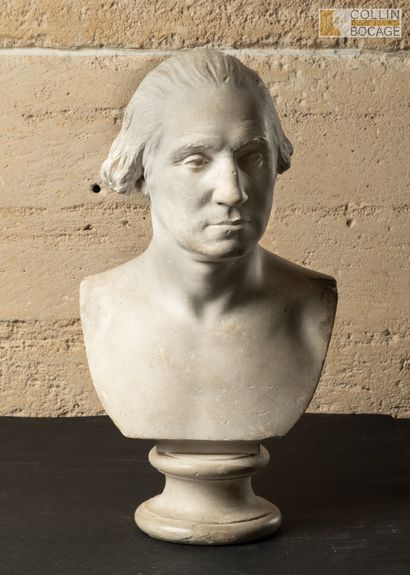
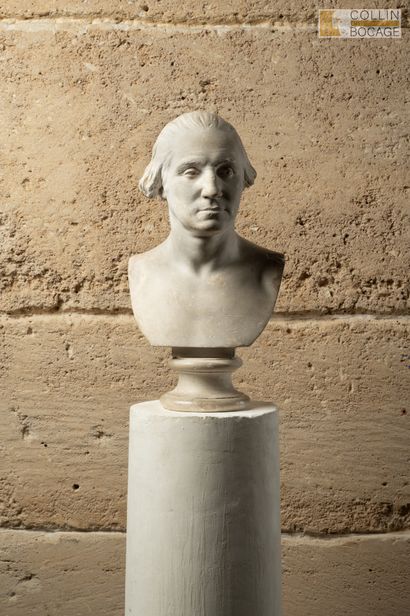
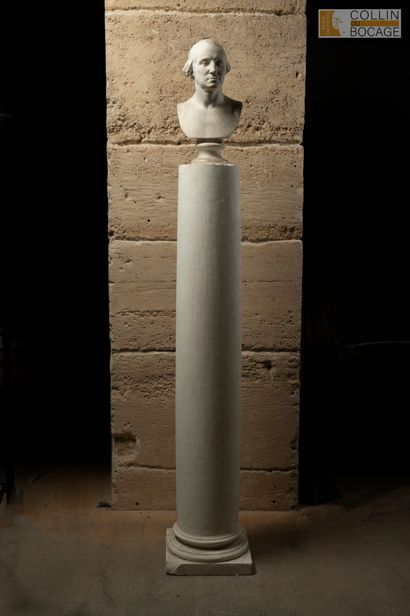
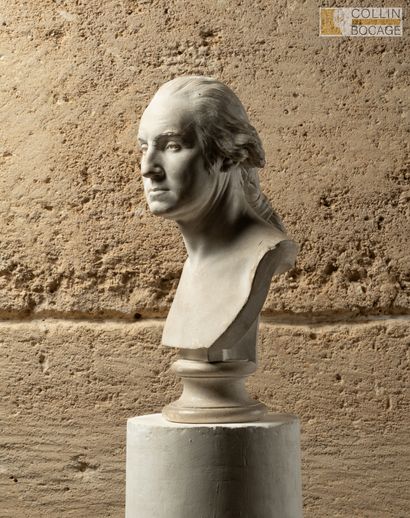
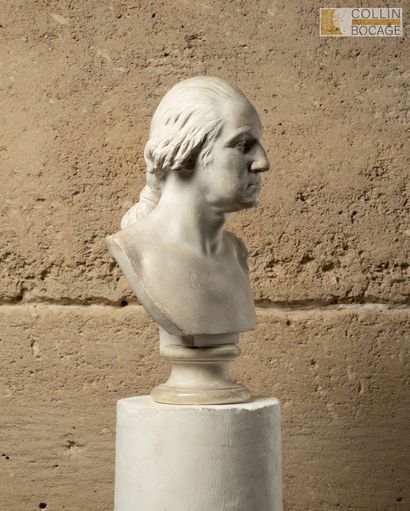
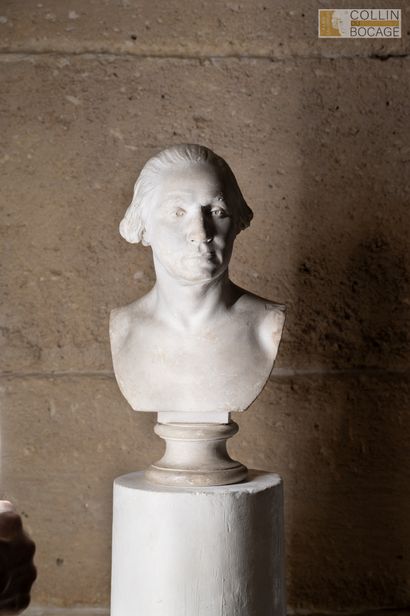
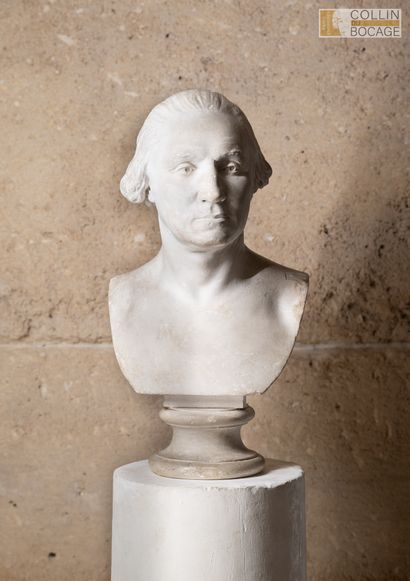
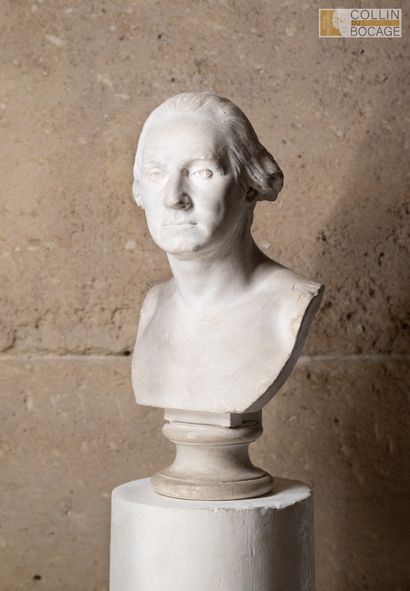
Plaster bust of George Washington (1732-1799)
Trace of an old label on the back; standing on a fully molded plaster pedestal
Height: 31.5 cm; Overall height: 38 cm
Provenance: French private collection.
Renowned for his talent as a portraitist, French sculptor Jean-Antoine Houdon was chosen in 1784 by Thomas Jefferson and Benjamin Franklin to create a life-size statue of George Washington, commissioned by the Virginia Legislative Assembly. In a letter to Washington dated December 10, 1784, Jefferson informed him that he had spoken about the statue to Houdon, "held in Paris to be the first sculptor in the world", and that Houdon, "enthusiastic about the idea of executing this work, has decided to travel to America for the necessary studies and to make a bust of Washington from life" (Giacometti, loc. cit., p.295).
It wasn't until June 23, 1785 that the Count of Angivillier, Director of the King's Buildings, gave Houdon six months' leave for "the trip you need to make to the United States, in order to execute the monument they propose to erect to General Washington..." (Archives nationales: B1 1918 196). With this leave, Houdon embarked from Le Havre on July 28, 1785, in the company of his friend Franklin, escorted by his three usual assistants - the molders and practitioners Begler and Michetti - and arrived in Philadelphia on September 14, 1785 (Giacometti, loc. cit., p.297). On October 2 or 3, 1785, Houdon arrived in Mount Vernon and set to work, as we learn from the Washington Journal: "On October 7, Friday, I posed, as I did for M. Houdon, who is making my bust... On October 10, Monday, I observed the procedures for preparing plaster of Paris and mixing it, according to M. Houdon's formula." On the 10th, we have already noted, with regard to the mask, that Washington relates with great interest the manner in which the plaster is prepared. Arnason concludes that a mold must have been made from the terracotta, and at least one plaster proof - if not two or more - which were admired in Philadelphia by Francis Hopkinson and Franklin, who persuaded Houdon to show a bust to Congress (Arnason, loc. cit., p.80). On October 19, "Wednesday, M. Houdon, having completed the work for which he came, left on Monday, October 17, with his pupils. His works and instruments were taken on board my ship for Alexandria, whence he took, on Tuesday morning, a carriage for Philadelphia." (Arnason, loc. cit., p.80).
From October 2 to 19, in Mount Vernon, Houdon produced a "life mask" in tinted plaster in imitation of terracotta, kept at the Morgan Library in New York (inv. AZ 129), as well as a terracotta bust signed and dated HOUDON F. 1785, kept at the Mount Vernon Museum. The latter was presented to the Ladies' Association, Mount Vernon, Virginia, in 1860 by Colonel John A. Washington (Seymour, op.cit.). It was undoubtedly from this original cast that Houdon took the impression for his plaster mold, as well as one or more prints in this material. Houdon arrived in Paris on Christmas Day 1785, and his assistants returned to France in May 1786, taking with them the molds for the bust. In 1789, Thomas Jefferson, then in Paris, acquired one of the plaster busts made in Houdon's studio. He sent the bust to Monticello; after Jefferson's death in 1826, it was deposited by his heirs, in 1912, at the Athenaeum in Boston (UH150).
The famous marble statue was not delivered until 1796, and is now housed in the Virginia State Capitol in Richmond.
We know that Houdon's portraits of the general were constantly re-edited during the artist's lifetime, in his Paris studio, to meet the demands of new clients. Different versions were created for specific commissions, such as the Versailles marble for Lucien Bonaparte's Galerie des Consuls. Houdon created three versions of the bust of George Washington: a first version "nude à l'antique", like the terracotta original made at Mount Vernon; a version in tunic and robe; and another in shirt and scarf. The bust shown here, although small, is one of the examples of the first "antique nude" version. The seams of the mould have been left visible. The small size and use of this type of mold may have been favored for transport reasons. We are also aware of two small marble busts (26.7 cm), representing Georges-Louis Leclerc, comte de Buffon (1707-1788), and Jean-Jacques Rous
My orders
Sale information
Sales conditions
Return to catalogue