

Lot n° 107
Estimation :
5000 - 7000
EUR
French school, c. 1757-1758. - Lot 107
French school, c. 1757-1758.
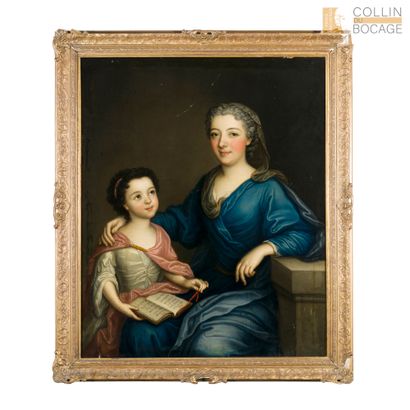
Double "antique" portrait of Louise-Henriette de Bourbon-Conti, Duchesse d'Orléans, and her daughter, Louise-Bathilde d'Orléans, future Duchesse de Bourbon.
Oil on canvas
100 x 81 cm
Gilded frame with foliage.
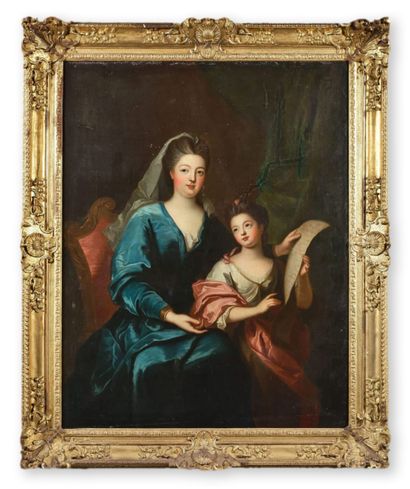
Our painting of Louise-Henriette de Bourbon-Conti (1726-1759), Duchesse d'Orléans and grandmother of King Louis-Philippe, with her daughter Louise Bathilde d'Orléans (1750-1822), future Duchesse de Bourbon, circa 1757-1758, was painted with the intention of using the same composition as a double family portrait painted 40 years earlier by Pierre Gobert, circa 1710-1715, depicting the maternal grandmother of the Duchesse d'Orléans: Louise-Françoise de Bourbon, daughter of King Louis XIV, Duchess of Bourbon and Princess of Condé, with one of her daughters, Henriette-Louise de Bourbon-Condé, known as "Mademoiselle de Vermandois". (See illustration B)
As a counterpart to this double family portrait painted 40 years earlier, we find in our painting, imbued with the same family and religious piety, the mother seated beside her standing granddaughter, both dressed in the same color garments as in the painting painted 40 years earlier, notably, for the Duchesse de Bourbon and the Duchesse d'Orléans, blue, the production of which really took off in Europe in the 18th century, thanks to the Spanish, French and English colonies in America (Guatemala, Santo Domingo and South Carolina), and gradually made its way into the clothing of all levels of society.
There are, however, a few differences that clarify the reasons why our portrait was commissioned, circa 1755-1760, and the message it is intended to convey.
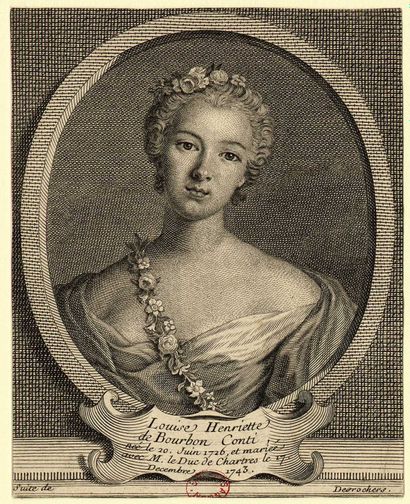
The Duchesse d'Orléans is dressed in clothes cut in the "antique" or "Greek" style, a fashion characteristic of the years 1755-1765 in Paris, which is not the case for her grandmother, whose portrait was painted between 1710 and 1715. In this sense, the two princesses both wore a veil, a symbol of piety and devotion to God. The Duchesse d'Orléans' veil is clearly inspired by the veil worn by married women in Greco-Roman Antiquity (see illustration), which is not the case for her grandmother's. What's more, the Duchesse d'Orléans' veil is dark, grey tending towards black, while her grandmother's is light, tending towards white.
And if, in both paintings, the granddaughter is holding a text from the Bible in the form of a parchment or book, in our portrait, the daughter of the Duchess of Orleans is holding the Old Testament, the first part of the Bible, the Hebrew account of the history of God's people before the birth of Jesus, in which the rules of the relationship between God and His people are set out, including God's wrath towards sinners.
The presence of the child and the Old Testament, combined with the Duchess of Orleans' wearing of the dark, antique veil of piety and devotion, convey the following message: it presents the Duchess as a mother, protecting and passing on her religious piety to her child, but also in her status as a married woman (with the antique-style devotional veil) who has renounced her past life as a sinner (fickle wife), which she is mourning (with the dark, grey-to-black color of the veil), in order to submit to God's authority by renewing her life free from sin and in faith in God.
In terms of its dimensions (100 x 81 cm), the intimacy of its composition, which echoes that of a family portrait painted 40 years earlier, and the message of family and religious piety it delivers to the viewer, our painting is not the result of chance inspiration on the part of the painter, but is undoubtedly the result of a commission placed with the artist, either by the Duc d'Orléans himself, or by his wife, shortly before his death.
The Duchesse d'Orléans, grandmother of the future King Louis-Philippe, may have commissioned this painting shortly before her death, reflecting her desire to put her life back in order and leave posterity with an image of herself that was a continuation of the one left 40 years earlier by her grandmother, full of piety and devotion, and therefore far removed from sin, thus breaking with the reputation of fickle wife that the Duchesse d'Orléans had throughout her life. But our painting may also have been commissioned by her husband, the Duc d'Orléans, either at the time of the duchess's death or shortly thereafter, with the aim of rehabilitating his wife in the eyes of the world, in order to
My orders
Sale information
Sales conditions
Return to catalogue