

Lot n° 105
Estimation :
8000 - 12000
EUR
Result without fees
Result
: 85 000EUR
Palestine, Ottoman period, 17th century - Lot 105
Palestine, Ottoman period, 17th century
(Bethlehem or Jerusalem)
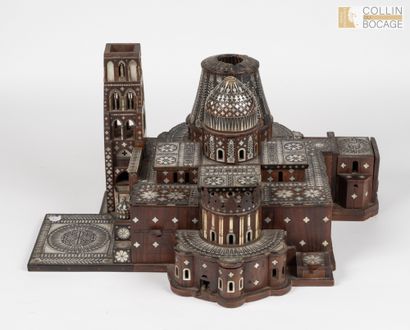
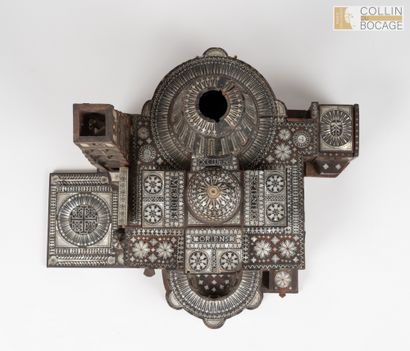
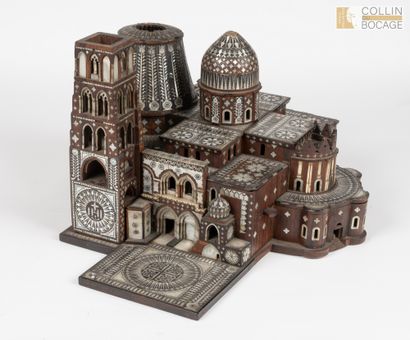
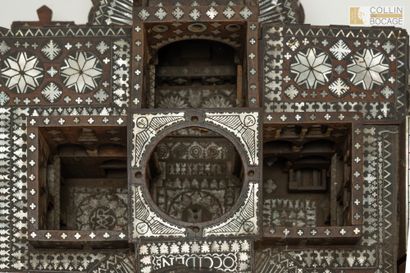
Rare, large architectural model of the Holy Sepulchre complex
Wood, bone and mother-of-pearl inlays
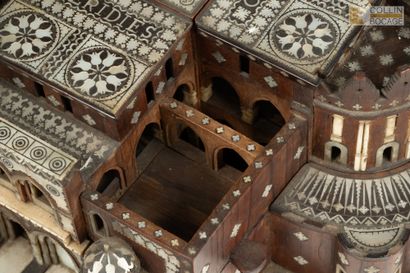
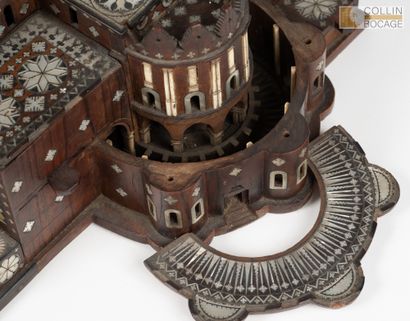
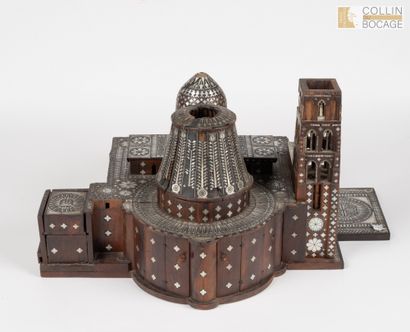
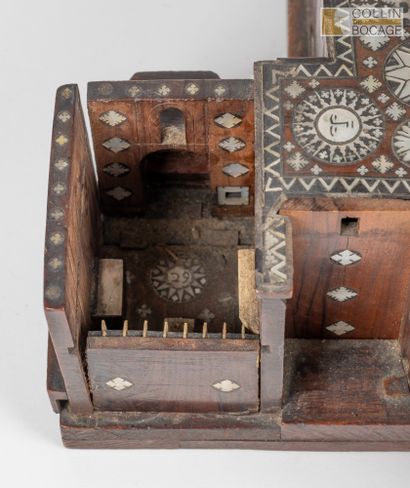
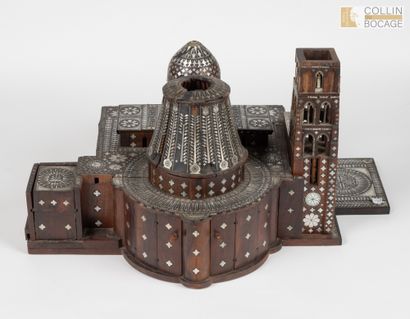
Architectural model in wood, richly inlaid with bone and mother-of-pearl, composed of several removable elements. It reproduces the main structures of the Holy Sepulchre in Jerusalem. The entrance square, adorned with a mother-of-pearl-inlaid Jerusalem cross, opens onto the Church of the Resurrection, topped by a central dome. Flanked on the west by the campanile and on the east by the Calvary chapel, this forecourt is the main entrance to the complex. Around the dome of the church, engraved bone plates indicate the cardinal points, a detail that testifies to the care taken in making this model. To the west, the church is extended by the Rotonde de l'Anastasis, characterized by its truncated cone-shaped dome. Several opening modules give access to identifiable internal spaces: Golgotha, the Stone of the Anointing, Christ's tomb. Finally, the aedicula of the Holy Sepulchre, designed to house Christ's tomb and the focal point of the pilgrimage, is represented by a second small model in olive wood inlaid with mother-of-pearl, which can be completely dismantled. Damage and missing parts. Damage and missing parts.
Size: 42 x 39 x 22 cm
Provenance: Theobald Theodor Friedrich Alfred von Bethmann Hollweg (1856-1921), German statesman. Bethmann Hollweg began his career as an ordinary civil servant, rising through the ranks during the German Empire before becoming Imperial Chancellor between 1909 and 1917.
Then by family inheritance.
The Palestinian models of the Holy Sepulchre are among the most unusual objects produced in the workshops of Bethlehem and Jerusalem under the Ottoman Empire. Both religious objects and works of art, they bear witness to the importance of Jerusalem's Church of the Holy Sepulchre in Christian piety. Designed for Western pilgrims, they combine the topographical fidelity provided by the surveys of the Franciscan Bernardino Amico (early 17th century) with the local know-how of bone and mother-of-pearl inlaying, emblematic of Palestinian Ottoman craftsmanship of the period.
The model presented here belongs to a select group of large dismantled models, rarely preserved in their entirety. Its multi-level structure allows us to observe the internal organization of the sanctuary: the Rotunda of the Anastasis, the adjoining chapels and the areas dedicated to the cult of the tomb. The presence of a separate, fully removable model of the aedicula is a notable feature, documented in the most elaborate examples.
The floral ornamentation in mother-of-pearl and bone, including stylized tulips, illustrates the integration of an Ottoman decorative vocabulary into an object intended for a Western Christian audience. These models are a fascinating testimony to the cultural exchanges between the Christian West and the Ottoman Islamic world. They embody, on the one hand, the spiritual expectations of Western pilgrims who acquired them as souvenirs and devotional objects, and, on the other, the craftsmanship of Bethlehem and Jerusalem artisans, imbued with the local techniques and traditions of the Ottoman Empire.
The published corpus contains only around thirty examples, preserved in the Ashmolean Museum, Oxford (AN1887.3089.2009.2), the British Museum (OA.10338), the Musée Sainte-Croix, Poitiers (2012.0.6) and the National Museum of Denmark, where an example is attested as early as 1674. The appearance of this unpublished model therefore represents an exceptional opportunity. In recent years, very few examples have been offered for public sale: among them, the one sold at Millon on October 6, 2022 (lot 1), now in the Musée du Louvre (RFML.ABCO.2022.28.1.0), and another, offered at Bonhams in London on July 6, 2011 (lot 28), now in the Museum of Fine Arts, Boston (2016.91). This new example is therefore part of a remarkably rare corpus, offering precious testimony to the fascination exerted by the Holy Sepulchre through the centuries.
My orders
Sale information
Sales conditions
Return to catalogue